

1. Air-oil separators: Controlling oil carryover after compression
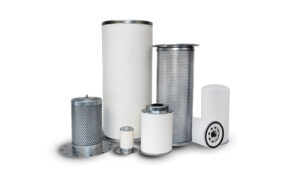
Air-oil separators are used in oil-injected compressor systems. During compression, oil becomes suspended in the compressed air as fine droplets or aerosols. The separator uses coalescing media to bring these droplets together so the oil can be recovered and returned to the lubrication circuit.
Effective separation helps control downstream oil carryover, reduce compressor oil loss, and support cleaner compressed air. Wrapped, depth, pleated, and spin-on formats address different airflow, aerosol load, pressure, service, and installation requirements.
Selection should consider the compressor type, rated airflow, operating pressure, acceptable pressure drop, required separation performance, dimensions, and fitment.
Compare Ashra’s air-oil separator formats 
Wrapped AOS | Depth AOS | Pleated AOS | Spin-on AOS
2. Air cleaners: Controlling contamination at the intake
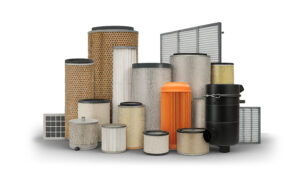
An air cleaner assembly is the complete intake-filtration assembly rather than the replaceable filter element alone. It typically includes a housing, primary filter element, and inner or safety element. Some systems also incorporate a pre-cleaner to remove larger contaminants before they reach the main filter.
Air cleaners control dust, dirt, moisture, and other airborne contaminants before air enters an engine or compressor. This helps limit abrasive wear and keeps contamination away from sensitive intake and internal components.
The correct assembly must provide the required airflow without excessive restriction while offering suitable contaminant capacity, structural durability, sealing, and fitment for the equipment.
Find the Ashra air cleaner suited to your intake conditions
Air cleaner assemblies | Pre-cleaner assemblies | Panel filters
3. Air filters: Balancing contaminant removal with airflow
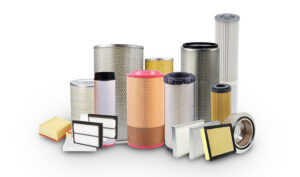
Air filters are the replaceable elements installed within an intake system. Their job is to capture airborne particles while maintaining the airflow required by the equipment.
Primary air filters carry the main contaminant load. Secondary or safety filters help protect the clean-air side during servicing and provide additional protection if the primary element is damaged or installed incorrectly.
A suitable air filter balances filtration efficiency, dust-holding capacity, initial restriction, structural strength, and service life. Media and construction should be matched to the contaminant load, airflow, duty conditions, housing, and sealing arrangement.
Explore Ashra air filters for primary and backup protection
Primary air filters | Secondary filters
4. Hydraulic and oil filters: Maintaining fluid cleanliness
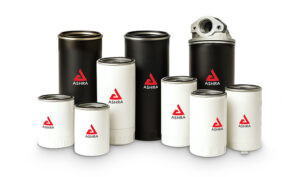
Hydraulic and oil filters capture solid contaminants as fluid circulates through hydraulic systems. These contaminants can abrade surfaces, obstruct close clearances, interfere with valves, and accelerate wear across pumps, motors, bearings, gears, and other components.
Hydraulic filtration solutions may be installed at different points in a system, depending on the circuit and the component being protected. Oil filters may also be used in engines, transmissions, industrial equipment, and compressor lubrication systems.
Selection involves the fluid, required cleanliness level, micron rating and efficiency, flow rate, operating pressure, temperature, bypass requirements, seals, installation format, and contaminant-holding capacity.
View Ashra’s hydraulic and oil filtration options
Transmission oil filters | Spin-on oil filters
5. Fuel filters and fuel-water separators: Keeping particles and water away from critical components
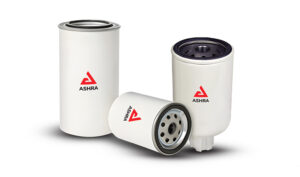
Fuel filters retain solid contaminants before they reach sensitive pumps and injection components, helping protect fuel delivery and combustion performance.
Fuel-water separators perform an additional role by removing water along with solid contaminants. This helps limit corrosion and wear across pumps and injectors while supporting more reliable engine operation.
Selection should consider fuel type, flow rate, particle size, filtration efficiency, water-separation requirements, pressure, temperature, contaminant capacity, material compatibility, and fitment.
Discover Ashra filtration for particles and water in fuel
Fuel filters | Fuel-water separators
6. Filter heads and accessories: Connecting the filter to the system
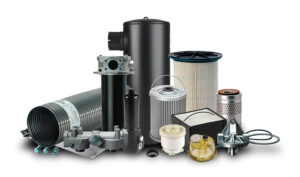
A filter head provides the physical and fluid connection between a replaceable filter and the surrounding system. It mounts the filter and directs fluid into and out of the assembly.
Porting, thread type, dimensions, material, casting quality, sealing surfaces, bypass arrangements, and installation space all affect integration and performance. An unsuitable head can create fitment problems, leakage, incorrect flow paths, or difficulties during servicing.
Accessories may support installation, monitoring, sealing, replacement, or maintenance. Both the head and its associated components should be specified as part of the complete filtration assembly.
Learn how Ashra develops and tests filter heads
Application-specific cast oil filter heads and related accessories
How to match the filtration solution to the system
Effective filtration begins with a clear understanding of the equipment, contaminant, operating conditions, and service requirements. From there, the relevant product category—and the specifications within it—can be selected with greater accuracy.
For accurate selection, start with the job the filter must perform. These six questions establish the technical brief:
- What must be protected?
Identify the compressor, engine, pump, valve, injector, bearing, transmission component, or downstream air network exposed to contamination. - What is moving through the system?
Define the intake air, compressed air, hydraulic fluid, lubricating oil, fuel, coolant, or other liquid involved. - What contamination is present?
Consider the particle type and load, dust, oil aerosols, moisture, water, and the conditions that introduce them. - What operating conditions apply?
Record flow, pressure, temperature, duty cycle, vibration, environmental exposure, and acceptable pressure drop or restriction. - What fitment must be matched?
Confirm dimensions, housing design, ports, threads, seals, installation space, current part number, and equipment model. - How will the filter be serviced?
Account for replacement intervals, access, restriction indicators, service environment, and the consequences of an incorrect match.
These factors should be assessed together. Consider this: A high-efficiency filter medium must still deliver the required flow, fit and seal correctly, withstand operating pressure and temperature, and provide suitable capacity for the expected contaminant load.
How different filtration products work together
Equipment often depends on several filtration solutions working across separate circuits.
A compressor may require an air cleaner at the intake, an air filter within that assembly, an oil filter within the lubrication circuit, and an air-oil separator after compression. Each protects a different part of the system from a different form of contamination.
An engine may rely on primary and secondary air filters, a lubricating oil filter, a fuel filter, and a fuel-water separator. Together, these filtration products control contamination entering through the intake, circulating with the oil, or traveling with the fuel.
Looking at filtration as a connected system helps buyers identify gaps, understand the role of each product, and select filters around the equipment’s complete operating requirements.
Read: ‘How filtration products are used across different industries’
Select, replace, customize: Find your fit with Ashra
Product selection, replacement matching, and customized development support.
Understanding filtration solution types is the first step. The next is matching the product, media, construction, and fitment to the application. In some cases, customized filter development is the right option. As a trusted filtration solutions partner, Ashra supports customers with what works best for them.
Ashra has manufactured industrial filters and separators since 1982. Our filtration portfolio covers intake air, compressed air, hydraulic and lubricating oil, fuel, industrial liquids, filter heads, and accessories for OE, replacement, aftermarket, and customized requirements.
This portfolio is supported by in-house engineering and testing.
More than 40 years of engineering and manufacturing experience support a disciplined approach, ensuring consistency through production.
Explore filtration products by Ashra, or share your application requirements for product selection, replacement matching, or customized development support.